October 10, 2026



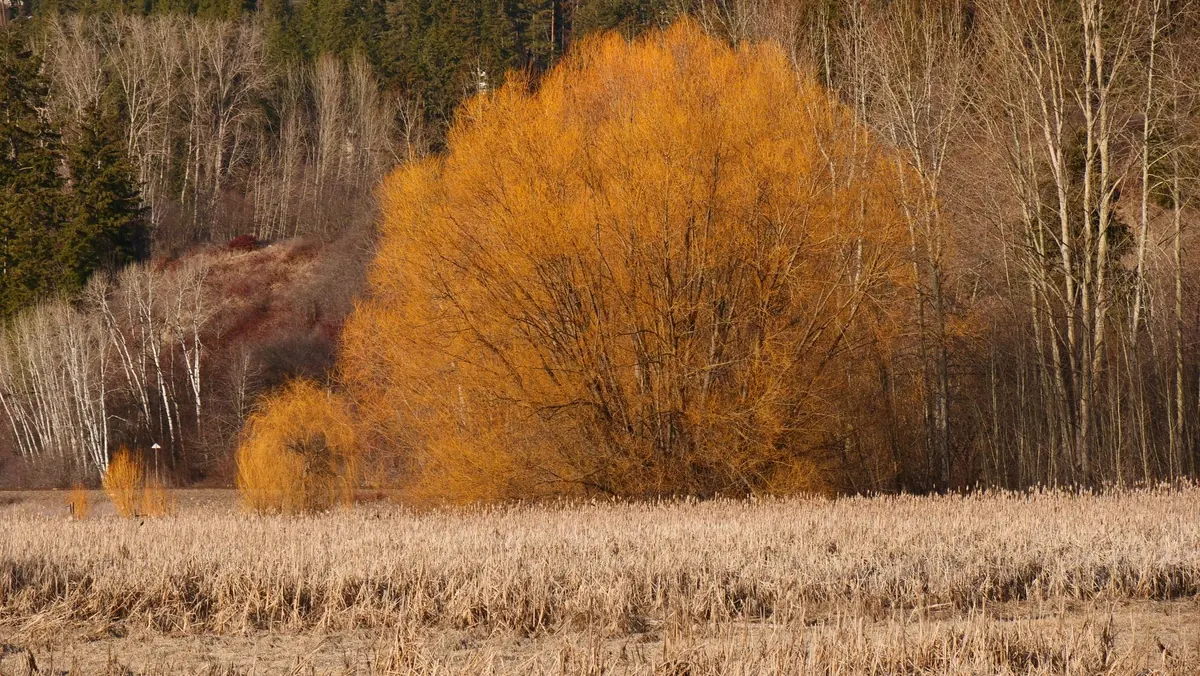
Willow is generous. Cut a stem almost anywhere and it will throw up fresh shoots within weeks, which is why this tree has been managed by cutting for centuries rather than left to its own devices. Coppicing and pollarding are the two traditional ways of doing it, and the difference between them comes down to a single decision: the height of the cut. Everything else — the size of the plant you end up with, the kind of stems you harvest, and how long it lives — follows from there.
Coppicing takes the stems down to, or very close to, ground level, leaving a low stump known as a stool. The willow responds by pushing up a cluster of straight rods from the base. The plant stays shrubby, rarely taller than the rods produced in each rotation.
Pollarding is the same operation performed higher up, usually between 1.8m and 3m. Stems are cut back to a swelling called the knuckle or head, and regrowth springs from there rather than from the ground. The tree keeps a trunk, a visible framework and a much smaller crown than it would naturally carry.
Both rely on the same trick. Willow stores energy in its roots and keeps dormant buds along its bark and at the base of every stem. Cut the top growth during dormancy and the plant redirects that energy into new shoots.
Coppicing gives you quantities of straight, single-season rods and keeps the plant permanently small. For basketry, cut on a one- or two-year cycle and harvest rods 1.5–2.5m long while the bark is still smooth. For stakes, beanpoles and binders, leave the rods three to five years. For biomass or firewood, seven to twelve years is not unusual — longer rotations give thicker stems and mean you need fewer stools.
Pollarding solves a problem coppicing cannot. It keeps regrowth out of reach of livestock and above the height of a person, while still limiting the crown. In a hedgerow, a pollarded willow gave timber and leafy fodder without shading out the whole field. In a small garden today it does something similar: you keep the trunk and the presence of a tree, but the crown stays compact and light reaches the ground beneath it.
The first cut matters most. Pollarding should start while the tree is young — ideally a sapling, or a stem no thicker than 10–15cm — so the knuckle forms cleanly and the tree builds its structure around it. Starting late on a mature willow means removing large limbs in one go, leaving wounds that seal slowly and are prone to decay.
Once a knuckle exists, maintenance is simple: take the regrowth back to the same point every two to five years, using the knuckle as your guide. Never cut below it into older wood, and never leave a fringe of stubs above it.
Weeping willows are a special case. They will regrow from a hard cut, but the long pendulous shoots are brittle and the tree's shape is easily spoiled. Selective thinning of the crown usually looks better than a full pollard.
Timing is the same for both methods: dormant season, late autumn through to late winter. Willow cut in midsummer will usually survive, but the regrowth is weaker and the plant suffers more from heat and drought.
For rods up to about 25mm, sharp bypass secateurs and loppers are enough. Anything thicker needs a pruning saw. Work above head height is a job for someone trained and insured — a pole saw, a ladder and a heavy limb are a poor combination. On the ground, cut on a slight angle facing away from the trunk so the wound sheds water, and avoid flush cuts into the parent stem.
Then feed the plant. A stool or pollard cropped repeatedly gives a great deal and takes nothing back. A mulch of garden compost or well-rotted manure over the rooting area every two or three years, applied in spring, keeps regrowth vigorous and the rods thick.
Willow is forgiving, which is why it invites sloppy work. The mistakes that matter are consistent: cutting too high when coppicing and leaving stubs that die back; tearing bark instead of making one clean cut; and cutting a mature tree hard in a single winter.
If you have a group of stools, cut them on a rotation — perhaps a third each year — so there is always some cover standing for birds and insects. Traditionally managed willow stools are long-lived, because regular cutting keeps the wood young and vigorous rather than letting it age into heavy, brittle limbs.
One practical caution. Willows are thirsty trees with vigorous roots. If a willow sits close to drains, foundations or a boundary, take advice before making significant cuts. It is also worth checking whether the tree is covered by a Tree Preservation Order or stands in a conservation area; your local planning department can confirm this, and consent is normally needed before work begins.
Pick one vigorous willow that has outgrown its spot and coppice it properly this winter: clean cuts, low stumps, brash cleared, stems sorted. By midsummer you will have a thick cluster of rods that tells you more than any guide can. If you would rather keep the tree's shape and height, choose a young one and start pollarding at about 2m, then hold the cut at that point for the life of the tree. Whichever route you take, keep to the cycle without fail. Willow in regular rotation stays healthy, straight and manageable; willow left alone for fifteen years and then cut hard is a far harder proposition.

Your guide to growing and using willow.
Copyright © 2026 Willow Guide. All rights reserved. Willow Guide.