
October 10, 2026


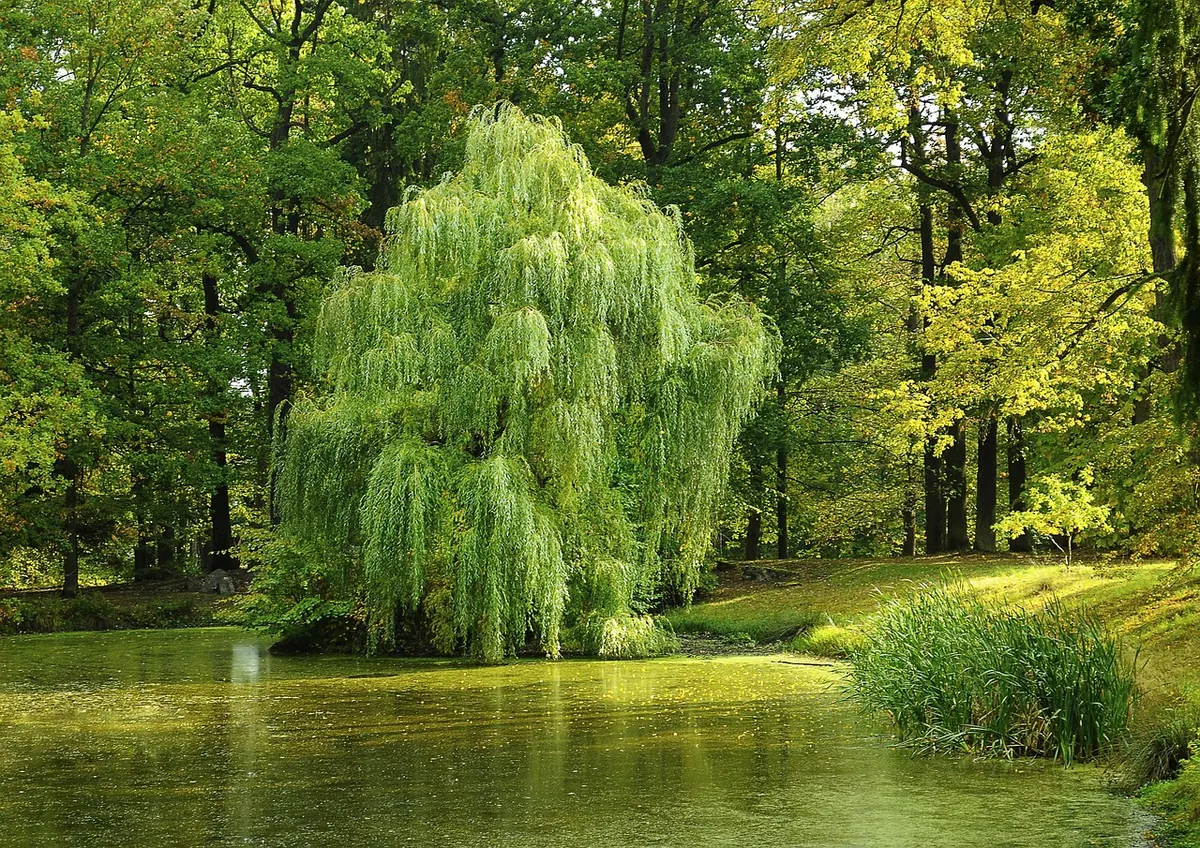
Willows and water go together. Walk along any riverbank in Britain and you will find them leaning out over the current, roots reaching into permanently damp ground. That heritage is why a willow can survive a wet winter better than almost anything else in the garden — and why a dry summer catches so many people out. A fortnight of thirty-degree days and no rain is a very different thing from a riverbank.
The good news is that willows are tougher than their reputation suggests. The trick is knowing how much to give, how often, and when to stop fussing.
There is no single watering number that suits every willow. A two-year-old Salix alba in a sandy bed needs far more attention than a mature weeping willow with roots somewhere near a field drain. So before you decide anything, push a trowel into the soil about 15cm down, an arm's length from the trunk. If it is cool and crumbly, you can wait. If it is dry and dusty, the tree is running on empty.
Soil type matters enormously. Sandy and gravelly ground drains within hours, so little and often works better there. Heavy clay holds water for days, which means you can soak deeply and then leave it alone. Mulched ground behaves like a third soil type entirely — usually the best one.
These figures are a sensible starting point for a hot, dry spell in southern or eastern England. Adjust up for sand, exposed sites and containers; adjust down for clay, shade and trees near water.
A standard watering can holds about 10 litres, so a mature tree's soak is five to ten cans. That sounds like a lot until you remember you are only doing it once a week.
The first three summers decide whether a willow establishes or merely survives. Its roots are still roughly within the original rootball, so water needs to land there — not spread across the lawn in the hope that roots will find it.
Build a shallow ring of soil or mulch around the trunk, about a metre across, and fill it slowly. A hose trickling for fifteen to twenty minutes is ideal; a bucket tipped over in ten seconds mostly runs off. If the ground is very dry and baked, water the ring once lightly, wait half an hour, then water it properly. The first pass softens the surface so the second can actually sink in.
Freshly planted whips and cuttings have almost no root system at all, so they dry out fast. Keep the soil around them consistently moist rather than soaking them once a week — a light watering every second day in hot weather is usually more useful than a flood on Sunday.
Older willows are surprisingly resilient. They drop leaves, thin the canopy and slow down, then push new growth when rain returns. A bit of leaf yellowing and early leaf fall in August is often a coping mechanism, not a death sentence.
For a mature tree, deep and infrequent is the rule. Watering the drip line — the ground beneath the outer edge of the canopy, where the feeding roots sit — does far more than soaking the trunk. Repeat every seven to ten days through a genuine drought. If your willow stands near a pond, stream, ditch or high water table, you may not need to water it at all beyond the first few years.
Water deeply, less often, and check the soil before you reach for the hose.
Some wilting at midday in full sun is normal. These signs are worth acting on:
Technique does most of the work. Water in the early morning or evening so less evaporates. Spread a 7–10cm layer of bark, compost or leaf mould over the root zone, keeping it clear of the trunk itself. A soaker hose coiled around the drip line is excellent for mature trees, and a couple of water butts take the pressure off the mains during a hosepipe ban.
Grey water from washing up or rinsing vegetables can be used on established willows. Avoid anything with bleach, borax or strong disinfectant, and don't use it on young trees or containers. Willows are tolerant, but they are not a waste-treatment system.
Check the soil twice a week. Water young willows twice weekly with 10–30 litres each, depending on age. Give mature trees one long soak every seven to ten days if the ground is dry at depth. Top up the mulch in June, before the heat arrives, and keep containers on a daily check.
If you can only manage one thing, make it the mulch and one deep weekly soak. Willows forgive a great deal, but they repay a little steady attention with some of the fastest, most generous growth in the garden. When in doubt, water the soil, not the tree.
Photo: Nennieinszweidrei / Pixabay

Your guide to growing and using willow.
Copyright © 2026 Willow Guide. All rights reserved. Willow Guide.